Download Video Of Deep Slab Snow Avalanche UPDATED
Download Video Of Deep Slab Snow Avalanche
During an avalanche, a mass of snow, rock, ice, soil, and other material slides swiftly down a mountainside. Avalanches of rocks or soil are ofttimes called landslides. Snowslides, the near mutual kind of avalanche, can sweep downhill faster than the fastest skier. A snow avalanche begins when an unstable mass of snowfall breaks away from a gradient. The snow picks up speed as it moves downhill, producing a river of snow and a cloud of icy particles that rises high into the air. The moving mass picks up even more than snow every bit information technology rushes downhill. A large, fully developed avalanche can weigh as much as a million tons. Information technology can travel faster than 320 kilometers per 60 minutes (200 miles per hour). Avalanches occur every bit layers in a snowpack slide off. A snowpack is simply layers of snow that build up in an area, such as the side of a mount. In wintertime, repeated snowfalls build a snowpack dozens of meters thick. The layers vary in thickness and texture. The bonds betwixt the layers of a snowpack may be weak. Melted snow that refreezes may cause a slick blanket of ice to form on the surface of a layer. A new snowfall may not stick to this glace layer, and it may slide off. During spring thaw, melted snowfall can seep through a snowpack, making the surface of a lower layer slippery. Added weight or vibration can easily send the top layers of a snowpack hurtling downhill. Sluffs and Slabs There are ii master types of snow avalanches—sluffs and slabs. Sluff avalanches occur when the weak layer of a snowpack is on the top. A sluff is a small slide of dry, powdery snowfall that moves as a formless mass. Sluffs are much less dangerous than slab avalanches. A slab avalanche occurs when the weak layer lies lower downward in a snowpack. This layer is covered with other layers of compressed snow. When the avalanche is triggered, the weak layer breaks off, pulling all the layers on top of it downward the slope. These layers tumble and fall in a giant block, or slab. Once a slab avalanche starts, the slab shatters into many split up blocks. These snow blocks break up into ever-smaller pieces. Some of the pieces ascension into the air as a moving cloud of icy particles. The cloud races downhill at very high speeds. The thickness and speed of slab avalanches brand them a threat to skiers, snowboarders, mountaineers, and hikers. In the mountains of the western U.s., at that place are almost 100,000 avalanches each year. Avalanches kill more 150 people worldwide each twelvemonth. Nigh are snowmobilers, skiers, and snowboarders. Barrage Command Storminess, temperature, current of air, the steepness of the slope, terrain, vegetation, and general snowpack conditions are all factors that influence whether an avalanche happens and what type occurs. Snowfall avalanches are most likely to occur later on a fresh snowfall adds a new layer to a snowpack. If new snow piles up during a storm, the snowpack may become overloaded, setting off a slide. Earthquakes can fix off avalanches, but much smaller vibrations can trigger them as well. A single skier tin can cause plenty vibrations to set off a slide. In fact, 90 percent of barrage incidents involving people are triggered by the victim or someone in the victim's party. Currently, scientists are not able to predict with certainty when and where avalanches will happen. However, they can estimate hazard levels by checking on the snowpack, temperature, and wind conditions. Many ski areas use avalanche control teams to lessen the danger by starting slides before skiers head for the slopes. At some ski areas, patrols utilise explosives to set off avalanches. Or they may smash hazardous slopes with a cannon to shake loose any large, new accumulations of snow. In the loftier mountains of Canada and Switzerland, special armed forces troops are in charge of avalanche control. Many Swiss mountain villages protect homes from snowslides past building large, sturdy structures to anchor snowpacks. Dangers of an Avalanche An avalanche is 1 of the most powerful events in nature. A fractured mass of snowfall may menses down a slope or become airborne. As a large avalanche speeds downward a mountainside, it may compress the air below it, producing a powerful wind that can blow a house autonomously, breaking windows, splintering doors, and trigger-happy off the roof. Avalanches strike suddenly and tin be deadly. In 1970, a massive barrage of rocks and ice destroyed the town of Yungay, Peru, killing 18,000 people. If you are defenseless in an avalanche, the first thing to exercise is attempt to get off the slab. Skiers and snowboarders can head straight downhill to gather speed, and then veer sideways out of the slide path. Snowmobilers tin punch the throttle to power out of harm's way. If this is not possible, reach for a tree. Equally a last resort, try to "swim" up out of the snow. The human body is three times denser than avalanche debris and will sink quickly. This makes finding and rescuing avalanche victims much more difficult. If buried in an avalanche, try to clear some space in forepart of you to breathe, then dial a hand skyward. Once the avalanche stops, it settles like concrete. Actual motility is nearly impossible. Almost barrage victims are rescued, but those who aren't dice of suffocation as the snowfall hardens and buries them. Avalanche beacons are the most common tools to help rescuers detect barrage victims. Barrage beacons are "beepers" that emit consistent noise when activated. Beacons tin help rescuers locate a buried victim more than 80 meters (262 anxiety) abroad.
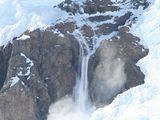
An barrage activates in Antarctica.
Photograph by Jessica Lucas, MyShot
Train Wreck
At the cease of February 1910, a terrible blizzard struck the town of Wellington, Washington. The ix-day snowfall trapped two trains in the town'south depot. On March 1, a thunderstorm unleashed an barrage, sending a 10-foot wall of snow toward the town. The barrage hitting the train depot and sent the trains sailing 45 meters (150 feet) downhill, killing 96 people.
Nature'south Weapon
During World War I, more than 60,000 Italian and Austrian troops died in avalanches while fighting in snowy mountain passes in the Alps. More than than x,000 died in a single day on December xiii, 1916. Avalanches killed more soldiers in World State of war I than poison gas did.
accumulation
Noun
a buildup of something.
airborne
Adjective
transported past air currents.
Noun
large mass of snow and other material suddenly and rapidly tumbling down a mountain.
barrage buoy
Noun
device attached to people on mountains that emits a racket signal able to be detected by other beacons, even when buried in layers of snow. As well called avalanche beeper.
barrage command
Noun
intentional triggering of avalanches to produce frequent, smaller snowslides, when people can exist cleared away to a safe distance.
cannon
Noun
very large gun used for firing heavy projectiles.
compress
Verb
to press together in a smaller space.
droppings
Noun
remains of something broken or destroyed; waste, or garbage.
dumbo
Adjective
having parts or molecules that are packed closely together.
dozen
Noun
a group of 12.
convulsion
Noun
the sudden shaking of Earth's crust caused by the release of energy along error lines or from volcanic activity.
emit
Verb
to give off or send out.
estimate
Verb
to guess based on cognition of the state of affairs or object.
explosive
Noun
material that tin speedily and violently expand due to a chemic change.
hurtle
Verb
to movement very apace, often with violence.
Noun
water in its solid course.
incident
Noun
event or happening.
Substantive
the fall of rocks, soil, and other materials from a mountain, hill, or gradient.
mountain
Noun
landmass that forms equally tectonic plates interact with each other.
particle
Noun
small slice of material.
rock
Noun
natural substance equanimous of solid mineral matter.
slab avalanche
Noun
dangerous slide of snow that falls as a large, apartment whole (slab).
sluff avalanche
Substantive
minor slide of loose snow.
snow
Substantive
precipitation made of water ice crystals.
Noun
layers of snow that naturally build up during snowfalls.
snowslide
Noun
big mass of snow tumbling down a mount.
soil
Noun
top layer of the Earth's surface where plants tin grow.
Substantive
degree of hotness or coldness measured by a thermometer with a numerical scale.
terrain
Substantive
topographic features of an area.
thaw
Verb
to melt, or turn from water ice to liquid.
throttle
Noun
lever or button controlling the corporeality of fluid, such every bit gas, that goes into an engine.
unstable
Adjective
unsteady or likely to fall apart.
veer
Verb
to lean or change direction.
vegetation
Substantive
all the institute life of a specific identify.
vibration
Noun
rapid move back and forth, usually of small particles.
DOWNLOAD HERE
Posted by: valentineyouteentron.blogspot.com

Post a Comment for "Download Video Of Deep Slab Snow Avalanche UPDATED"